
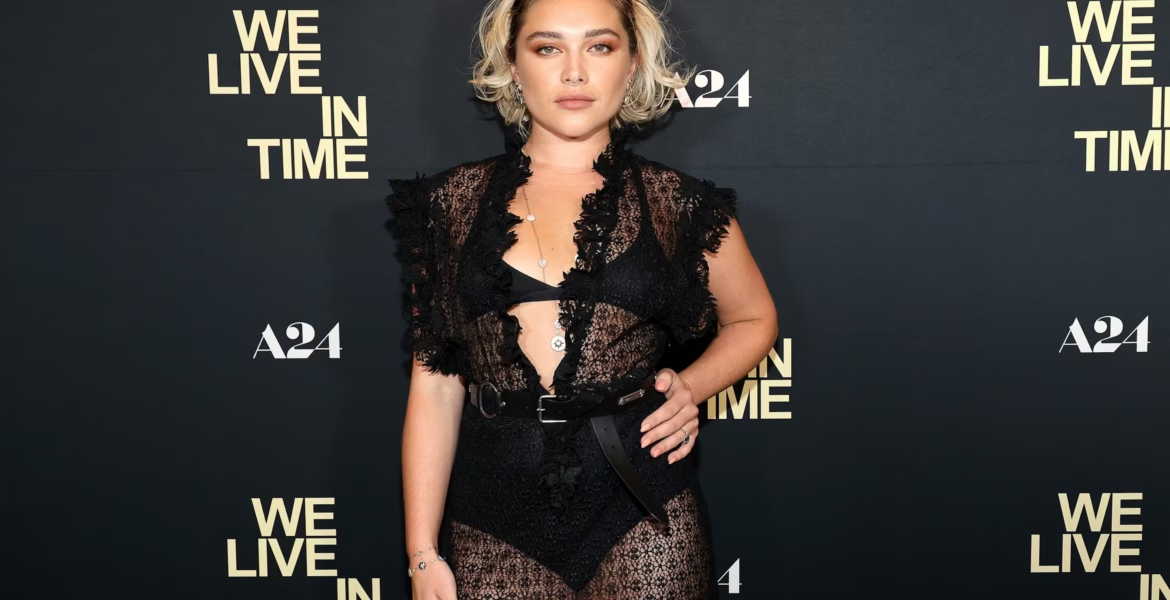
Florence Pugh brought one of the most complicated figures in J. Robert Oppenheimer’s life to the screen in Christopher Nolan’s Oppenheimer. As Jean Tatlock, Pugh portrays a brilliant psychiatrist, writer, and Oppenheimer’s former romantic partner whose relationship with the physicist continued to affect him long after they separated.
The Florence Pugh Oppenheimer connection is especially interesting because Jean Tatlock was a real historical figure, not simply a fictional love interest created for the movie. Her intelligence, political interests, relationship with Oppenheimer, and tragic death all shaped the way Nolan approached the story. Pugh also researched photographs and historical accounts to understand the woman behind the famous relationship. This guide explores Jean Tatlock’s real life, Pugh’s performance, her chemistry with Cillian Murphy, the character’s importance to the story, and why the role remains one of the most memorable parts of Oppenheimer.
Who Does Florence Pugh Play in Oppenheimer?
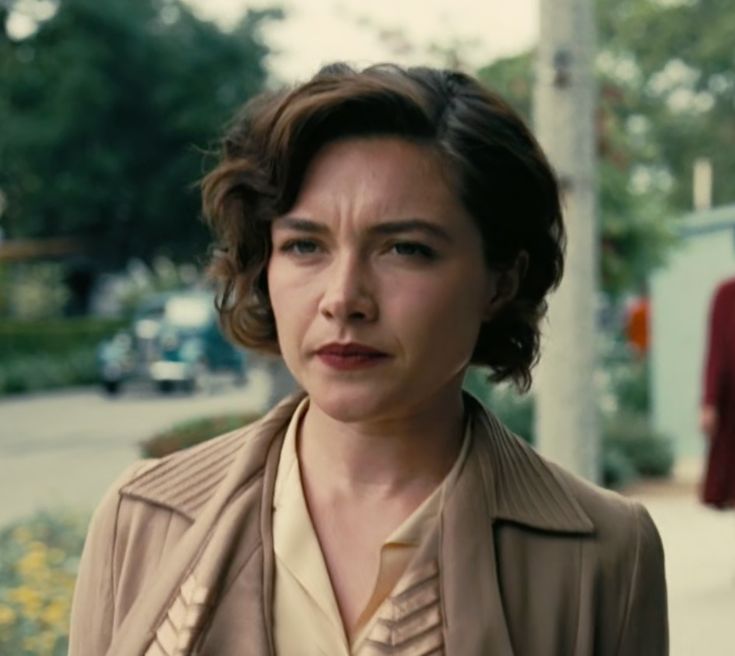
Florence Pugh plays Jean Tatlock, a psychiatrist and writer who had a significant romantic relationship with J. Robert Oppenheimer. The pair met in 1936 and became close, with Oppenheimer reportedly proposing to Tatlock twice. Their relationship continued intermittently even after Oppenheimer married Katherine “Kitty” Puening.
Tatlock is important to the film because she reveals a more personal side of Oppenheimer. Much of the movie focuses on physics, politics, government investigations, and the Manhattan Project, but his relationship with Tatlock gives the audience a window into his emotional life.
Pugh’s role is therefore more than that of a romantic supporting character. Jean is portrayed as intelligent, independent, politically aware, and emotionally complicated. Her presence helps demonstrate that Oppenheimer’s life cannot be understood solely through his scientific achievements.
Florence Pugh’s Jean Tatlock at a Glance
| Detail | Information |
|---|---|
| Actress | Florence Pugh |
| Character | Jean Tatlock |
| Film | Oppenheimer |
| Director | Christopher Nolan |
| Co-star | Cillian Murphy |
| Character's profession | Psychiatrist and writer |
| Historical connection | Romantic partner of J. Robert Oppenheimer |
| Film release | 2023 |
| Based on | American Prometheus |
Who Was the Real Jean Tatlock?
Jean Tatlock was a real historical figure whose life extended far beyond her relationship with Oppenheimer. She graduated from Vassar College in 1935 and later studied medicine at Stanford, eventually becoming a psychiatrist. She also worked as a writer and reporter for the Western Worker, a publication associated with the American Communist Party.
Tatlock met Oppenheimer in 1936 while he was teaching at Berkeley. Their relationship became serious, and the two were reportedly close enough to marriage on more than one occasion. Even after Oppenheimer married Kitty in 1940, he continued to see Tatlock.
Her intellectual interests were an important part of the relationship. Tatlock was not simply someone Oppenheimer dated; she challenged him intellectually and introduced him to political ideas that would later become relevant to scrutiny surrounding his career.
Her tragic death in 1944 added another layer to Oppenheimer’s story. Tatlock died by suicide at her San Francisco apartment, before the Trinity test and the atomic bombings of Hiroshima and Nagasaki.
How Did Florence Pugh Prepare to Play Jean Tatlock?
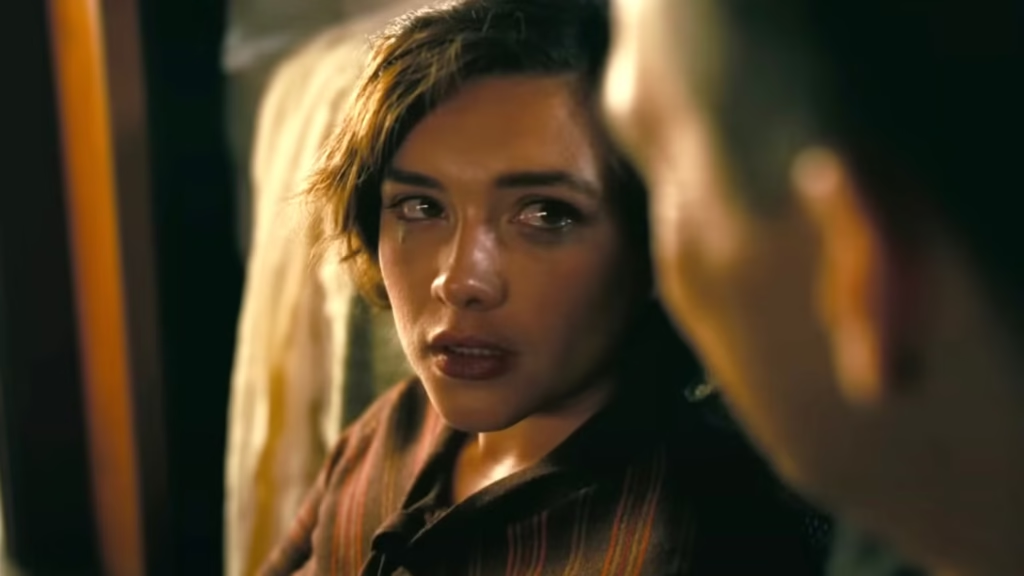
Pugh approached Jean Tatlock as a real person rather than treating her as a conventional movie love interest. Historical photographs became an important part of her research, particularly images showing Tatlock and Oppenheimer together.
Pugh noted that the photographs showed Tatlock as someone who appeared playful and expressive. That helped her think beyond the historical labels attached to Tatlock and imagine what kind of person could capture Oppenheimer’s attention.
The actress’s approach was important because Tatlock needed to feel like a fully developed person. If the character had been written only as “Oppenheimer’s lover,” the relationship would have lacked depth.
Instead, Pugh emphasized Tatlock’s intelligence and independence. Her character is someone capable of challenging Oppenheimer rather than simply admiring him.
That distinction gives their relationship more credibility. Oppenheimer was one of the most intellectually ambitious people of his generation, so portraying the person who attracted him required an actress capable of conveying an equally strong personality.
What Was Jean Tatlock’s Relationship With Oppenheimer?
Oppenheimer and Tatlock met in 1936 and began dating soon afterward. Their relationship became serious enough that Oppenheimer proposed to her twice, although neither proposal resulted in marriage.
Their connection was complicated by Tatlock’s mental health struggles, political interests, and Oppenheimer’s eventual marriage to Kitty. The two continued seeing each other intermittently even after Oppenheimer’s marriage.
The movie uses this relationship to reveal Oppenheimer’s emotional contradictions. He is ambitious and intellectually confident, but his personal relationships are much less orderly.
Tatlock also represents a part of Oppenheimer’s life that cannot be separated from the political climate of the era. Her association with Communist politics became relevant during the security concerns surrounding Oppenheimer.
This ultimately connects the personal story to the larger political narrative. A relationship that might initially appear private becomes part of the evidence examined during Oppenheimer’s 1954 security hearing.
| Aspect | Details |
|---|---|
| When they met | Jean Tatlock and J. Robert Oppenheimer met in 1936 and began a serious romantic relationship later that year. |
| Nature of relationship | Their relationship was intense and complicated, with strong romantic and emotional ties. |
| Marriage proposals | Oppenheimer reportedly came close to marrying Tatlock twice, but she declined his proposals. |
| Political influence | Tatlock introduced Oppenheimer to left-wing and Communist political circles, which later became relevant during his security-clearance controversy. |
| Relationship after 1939 | Tatlock ended the relationship in 1939, although the two remained emotionally connected and saw each other occasionally. |
| Oppenheimer’s marriage | Oppenheimer married Katherine “Kitty” Puening in 1940, but he continued to have contact with Tatlock. |
| Last significant meeting | In June 1943, Oppenheimer travelled to San Francisco to see Tatlock while she was struggling with depression. He spent the night at her apartment. |
| Why it mattered later | Oppenheimer’s relationship with Tatlock and her political associations were examined during his 1954 security hearing. |
| How Oppenheimer described her | In his 1954 statement, Oppenheimer said they had been very close and had been at least twice close enough to marriage to consider themselves engaged. |
Why Is Jean Tatlock Important to Oppenheimer?
Jean Tatlock plays an important role because she connects several major themes in the film: love, politics, science, guilt, and memory.
Oppenheimer’s relationship with Tatlock provides the movie with emotional material that contrasts with the technical world of the Manhattan Project. While scientists discuss equations and nuclear weapons, Oppenheimer’s personal life remains complicated and often unresolved.
Tatlock also introduces political ideas into his world. Historical accounts describe her connection to Communist politics, and Oppenheimer’s associations with Communist Party members later became a major issue during his security hearing.
This means her role extends beyond romance. Her presence helps explain why certain aspects of Oppenheimer’s past became politically dangerous.
The character also contributes to the film’s exploration of guilt. Oppenheimer’s later achievements cannot be separated completely from the people and relationships he left behind.
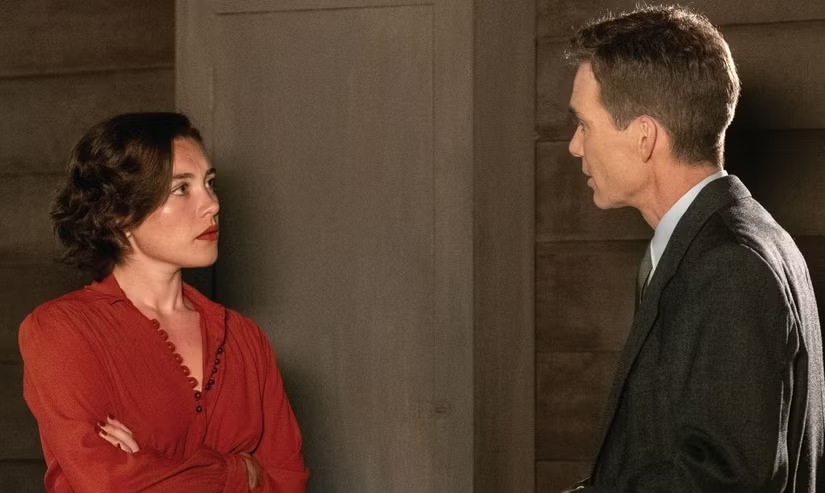
Florence Pugh and Cillian Murphy’s Chemistry
Florence Pugh and Cillian Murphy needed to establish a believable relationship despite having relatively limited screen time compared with the enormous historical scope of Oppenheimer.
Their scenes work because the relationship feels intellectually driven as well as romantic. Tatlock challenges Oppenheimer, and he is clearly fascinated by her personality.
Pugh brings a directness to Jean that contrasts with Murphy’s more reserved portrayal of Oppenheimer. Their differences create tension without requiring constant dramatic confrontation.
The relationship also feels imperfect, which makes it more believable. Neither character is presented as an idealized romantic figure. They have disagreements, complicated emotions, and different needs.
That complexity is essential to Nolan’s approach. The director did not want Oppenheimer to become only a scientific biography. The relationships provide the emotional structure that makes the historical events more personal.
Did Jean Tatlock Introduce Oppenheimer to Communist Politics?
Jean Tatlock’s political interests are an important part of her historical connection to Oppenheimer. According to accounts discussed in Men’s Health, Tatlock introduced Oppenheimer to Communist Party politics and was herself associated with the Communist Party at different points.
This became significant because Oppenheimer’s political associations were later investigated during the McCarthy era. His relationships with Communist Party members and his own political connections became part of the scrutiny surrounding his security clearance.
The film uses this history carefully. Jean is not portrayed simply as a political influence who “caused” Oppenheimer’s problems. Instead, her relationship with him forms one part of a much broader network of associations.
That distinction matters because Oppenheimer’s political history was complex. His views and relationships evolved over time, and his 1954 hearing examined many aspects of his past.
Jean’s role therefore links Oppenheimer’s private life to one of the most consequential political chapters of his career.
| Aspect | Details |
|---|---|
| Political influence | Yes, Tatlock introduced Oppenheimer to left-wing circles. |
| Their relationship | They met and began dating in 1936. |
| Tatlock’s beliefs | She was involved with Communist politics. |
| Oppenheimer | He never formally joined the Communist Party. |
| Later impact | His political associations became important during his 1954 security hearing. |
What Happened to Jean Tatlock?
Jean Tatlock died on January 5, 1944, at her apartment in San Francisco. Her father discovered her body after she drowned herself. She had been receiving psychiatric treatment and was struggling with severe depression.
Her death occurred before Oppenheimer’s work at Los Alamos reached its climax. She did not live to see the Trinity nuclear test in July 1945 or the atomic bombings of Hiroshima and Nagasaki.
That timing gives her story an especially tragic quality. Tatlock was closely connected to the man who would become one of the central figures in the development of nuclear weapons, yet she died before the world witnessed the consequences of his work.
Her death also remained significant in Oppenheimer’s personal history. The film uses the relationship and its aftermath to explore the emotional burdens that Oppenheimer carried.
It is important, however, not to reduce Tatlock’s life to her death. She was an accomplished student, psychiatrist, writer, and politically engaged intellectual in her own right.
How Accurate Is Florence Pugh’s Jean Tatlock?
The film is based largely on Martin J. Sherwin and Kai Bird’s biography American Prometheus: The Triumph and Tragedy of J. Robert Oppenheimer. The book provides the historical foundation for many of the relationships and events depicted in Nolan’s film.
Pugh’s portrayal captures several major elements of Tatlock’s documented life: her intelligence, medical career, political interests, relationship with Oppenheimer, and emotional struggles.
However, viewers should remember that Oppenheimer is a dramatic film rather than a documentary. Dialogue, chronology, scene construction, and character interactions can be shaped for storytelling.
The core historical relationship is real, but individual scenes should not automatically be treated as exact transcripts of what happened.
That is especially important when discussing intimate conversations. Historical sources can establish that two people met or had a relationship, but they cannot always establish precisely what they said to each other in private.
Florence Pugh Oppenheimer Premiere Look
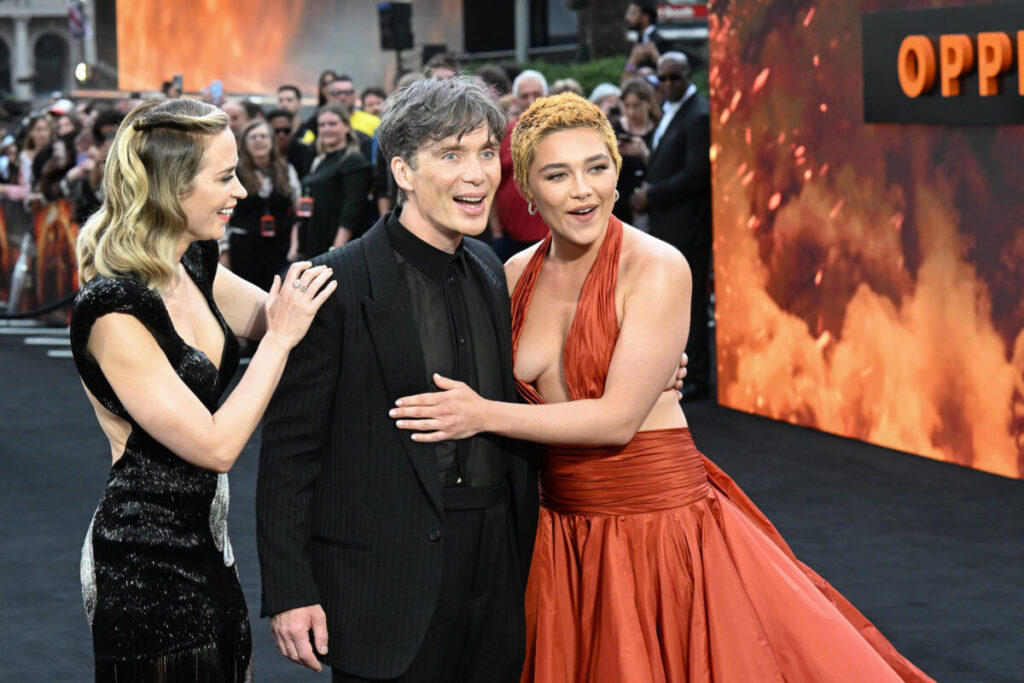
Pugh also attracted considerable attention during the Oppenheimer promotional tour. At the London premiere, she wore a dramatic orange Valentino couture gown featuring cut-out details, a plunging halter neckline, an open back, and a flowing train. Her buzzed hairstyle was also coordinated with the orange shade of the dress.
The look quickly became one of the most discussed fashion moments surrounding the film’s release.
Pugh’s promotional style had already generated attention before the London premiere. Her outfits during the press tour included bold colours and dramatic silhouettes, creating a visual identity that complemented the high-profile release.
The fashion coverage shows how Pugh’s Oppenheimer appearance existed on two levels. On screen, she played a historically significant woman in a serious biographical drama. Off screen, she became one of the movie’s major fashion and celebrity talking points.
How Florence Pugh’s Role Differs From Her Other Characters
Pugh has built a reputation for playing emotionally complicated characters. Her filmography includes Lady Macbeth, Midsommar, Little Women, Black Widow, Don’t Worry Darling, and The Wonder.
Jean Tatlock fits naturally into that career because the character requires emotional depth rather than a simple heroic or villainous performance.
However, Tatlock is different from some of Pugh’s more physically demanding roles. The challenge here was making a historically documented person feel alive while respecting the seriousness of her story.
Pugh’s performance relies heavily on dialogue, expression, and the tension between Jean’s confidence and vulnerability.
That restraint is one reason the role stands out. She does not need a large number of scenes to leave an impression.
Why Did Christopher Nolan Cast Florence Pugh?
Christopher Nolan’s Oppenheimer features an unusually large ensemble cast, including Cillian Murphy, Emily Blunt, Robert Downey Jr., Matt Damon, David Krumholtz, Benny Safdie, and many others.
Pugh’s casting was particularly useful because Jean Tatlock needed to feel intelligent and formidable enough to hold her own opposite Murphy’s Oppenheimer.
The role also required emotional vulnerability. Tatlock’s story moves from intellectual confidence and romantic connection toward psychological distress and tragedy.
Pugh has demonstrated that range throughout her career, making her a natural fit for a character who cannot be reduced to one emotional quality.
Her performance ultimately gives Tatlock a sense of individuality. She feels like someone who existed independently of Oppenheimer, even though the movie necessarily tells her story through its connection to him.
Florence Pugh Oppenheimer: Why the Role Matters
The Florence Pugh Oppenheimer connection matters because Jean Tatlock provides one of the film’s strongest links between Oppenheimer’s personal and professional worlds.
Without Tatlock, the story could become dominated by science, politics, and the Manhattan Project. Her character reminds viewers that Oppenheimer was also a man dealing with love, loss, guilt, ambition, and complicated personal choices.
Pugh’s performance gives those themes a human face.
Jean also helps explain why Oppenheimer’s past became politically significant. Her political associations were not simply historical trivia; they became part of the broader scrutiny surrounding the physicist.
Most importantly, the film gives audiences a reason to remember Tatlock as more than “Oppenheimer’s girlfriend.” She was a trained psychiatrist, writer, intellectual, and politically engaged woman whose own life deserves attention.
Frequently Asked Questions
Who does Florence Pugh play in Oppenheimer?
Florence Pugh plays Jean Tatlock, a psychiatrist and writer who had a significant romantic relationship with J. Robert Oppenheimer.
The character is based on a real historical figure.
Was Jean Tatlock a real person?
Yes. Jean Tatlock was a real psychiatrist, writer, and former romantic partner of Oppenheimer.
She lived from 1914 to 1944 and died before the first atomic bomb test.
Was Florence Pugh nominated for an Oscar for Oppenheimer?
No. Pugh was not nominated for an Academy Award for her performance as Jean Tatlock.
The film received multiple Oscar nominations and wins, including recognition for Cillian Murphy and Robert Downey Jr.
Did Jean Tatlock marry Oppenheimer?
No. Oppenheimer reportedly proposed to Tatlock twice, but they never married.
Oppenheimer later married Katherine “Kitty” Puening.
What happened to Jean Tatlock?
Jean Tatlock died by suicide in January 1944 at her San Francisco apartment.
Her death deeply affected the historical story surrounding Oppenheimer.
Conclusion
Florence Pugh Oppenheimer is a fascinating pairing because Pugh’s role as Jean Tatlock brings one of the most personal and complicated parts of J. Robert Oppenheimer’s life to the screen. Tatlock was not merely a romantic figure. She was an accomplished psychiatrist, writer, and politically engaged intellectual whose relationship with Oppenheimer influenced both his personal life and the later scrutiny of his political associations.
Pugh’s preparation helped give the character personality beyond the historical record. By studying photographs and thinking about Tatlock’s intelligence and individuality, she created a character who feels like a real person rather than a plot device.
Her chemistry with Cillian Murphy also strengthens the movie’s emotional side, while the attention surrounding Pugh’s London premiere fashion added another dimension to her connection with the film.
Ultimately, Jean Tatlock is one of the reasons Oppenheimer feels like more than a story about the atomic bomb. Through Pugh’s performance, audiences see the personal relationships, difficult choices, and emotional consequences behind one of the most consequential scientific stories in modern history.
Also Read: Jon Bernthal Net Worth
You may also like


Leave a Reply